Posts

PRUNING YOUR HYDRANGEAS

Image
If your hydrangeas live in the milder parts of the U.S. and Europe, and the spirit moves you, you can consider pruning your new wood blooming hydrangeas now. It's hard to conceive of that when you live where I do. Last March we had 3 Nor’easters. Not only did they bury everything, but the snow and ice made the footing much too dangerous to be using sharp tools. On the other hand, we have had an extremely mild February and early March looks to be the same. Exactly which plants am I talking about? The ones that are foolproof and will produce flowers on the stems they will grow this year.

THE LANGUAGE OF HYDRANGEAS

Image
Valentine’s Day is the perfect time to learn about the language of hydrangea flowers. We’re talking here about the most popular hydrangea, known as mophead, hortensia, pompom or big leaf. Botanically, it’s Hydrangea macrophylla . Blue mophead hydrangea flowers

FEELING HYDRANGEA-STARVED?

Image
Feeling hydrangea-starved? That describes me a week or two ago. Then we had two consecutive days of temps in the 60s. That gave me a terminal case of spring fever! But I knew enough not to rush out and start playing with my hydrangeas. Living in zone 5, there’s a lot of winter still ahead of me. February is right around the corner and then there are the cruel 31 days of March. So what’s a hydrangea-lover to do? 

Deer Damage on Hydrangeas in Winter

Image
This is the time of year to be alert to deer damage on hydrangeas. The weather pattern of deep cold, snow, and ice storms has made it increasingly difficult for them to get around and find food sources to sustain life. Deer tracks are the obvious tip off so here's what to look for:    DEER TRACKS IN SNOW: NOTE CLOVEN HOOF

Preparing Hydrangeas for Winter

Image
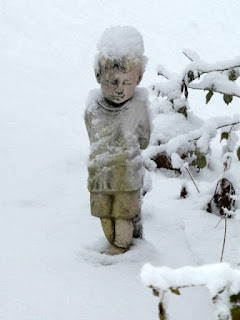
Boy Caught in Snowstorm We have had a few nights where the temps have dropped in to the high 30s, a stark reminder that it’s time to prepare to wrap some of my bigleaf (macrophyllas) and mountain (serratas) hydrangeas for winter. Those that aren't planted in protected locations as I described in my other blog posts,  https://bit.ly/2lRGNlm  and  https://bit.ly/2A8tzZE  need a little help if I want to give them their best chance of having their buds make it through the coming winter to see flowers in 2020.  Exactly what does this mean right now? SHRUB COVERS : something to safely protect the plants from ice and snow, maybe even give them a few degrees of insulation.

LEAF SPOTS ON HYDRANGEA

Image
HYDRANGEA MACROPHYLLA WITH DISEASED FOLIAGE On my recent garden visits, I’ve noted an abundance of leaf spots and unsightly foliage on hydrangeas. They can be bacterial leaf spot from an infection by Xanthomonas campestris, or Cercospora which grows from the pathogen Cercospora hydrangeae . I’m also seeing powdery mildew on many plants. You can thank Erysiphe friesii var. friesii (formerly Microsphaera friesii ). If you’ve got blemished foliage, a trip to your local extension office can diagnose which it is so you can apply the proper treatment, if at all.

WEBWORMS ON PANICLE HYDRANGEAS

Image
In July, I wrote about webworms (Hyphantria cunea) on panicle hydrangeas. For the past several weeks , the second generation has been active in my neck of the woods. And boy, are they active! It seems every day they form new webs where none were the previous day. That will continue through October or until the first killing frost. Ugly doesn’t come close to what the plant looks like when these beasties are at work.

PANICLE HYDRANGEAS ON PARADE

Image
I have been roaming around these past few weeks, visiting open gardens throughout my local area. The panicle hydrangeas have been just glorious in every garden I have seen with their undeniably spectacular flowers and form. Not to mention the impressive flowers of oak leaf hydrangeas are showing their magnificent colors as well.

HYDRANGEA CARE FOR JULY – PART TWO

Image
Hard to believe we are past mid-July – already! NOW is the time to take care of a couple of hydrangea chores, ideally by August 1.

HYDRANGEA CARE FOR JULY

Image
If your garden is anything like mine, right about now insects and disease start rearing their ugly heads. In most cases, they show up as a result of cultural conditions. Here’s the low down on what I am seeing right now which may match what’s happening in your garden as well.

REPORTING 2019 WINTER IMPACT ON HYDRANGEAS

Image
Time to report on winter's impact on my hydrangeas . In early May, I went out to my Zone 5 garden to see what winter had done to my hydrangeas that bloom on old wood: macrophyllas (big leaf) and hydrangea serrata s (mountain). I also checked on the quercifolias (oak leaf) and petiolaris (climbing).  But we had a very cool and wet spring and this inspection tour was too early for our delayed season. 

Climbing Hydrangea, A Plant For All Gardens

Image
Climbing Hydrangea on Arbor  If you’re lucky enough to have a climbing hydrangea (hydrangea anomala petiolaris ), you already know what a fabulous plant it is. And right now it is in its glory in my zone 5B garden. The fact that it grows in shade and is drought tolerant makes it doubly attractive. And in my little slice of heaven, deer have avoided it for 28 years.   The beautiful lacecap flowers are once again dependably in full view. Not only are they beautiful but they are perfuming the garden. Since I have it planted in several places, its non-stop scent practically follows me around. Climbing Hydrangea Flower It’s not uncommon to see this shade loving vine draping arbors and adorning walls. It works really well climbing a tree which does the tree no harm. It’s also a plant you can use as a groundcover. The glossy foliage will scramble over anything in its way. An unsightly tree stump for example is one such eyesore you can make disappear. Know, howeve...

ARE THE LEAVES ON YOUR 'ANNABELLE' STUCK TO EACH OTHER?

Image
Cupped leaves on Hydrangea arborescens Are the leaves on your 'Annabelle' hydrangeas stuck to each other? Inspect them and any other hydrangea arborescens you may have like Incrediball ® or Invincibelle ® Spirit. You may notice some leaves cupped together. It looks like the leaves above from my Invincibelle ® Spirit.  Interesting, huh? Don’t panic!

PRUNING YOUR OLD WOOD FLOWERING HYDRANGEAS

Image
Now that you have completed cutting back your new wood blooming hydrangeas, it's time to look at what's happening with your old wood plants. Which ones are these? Your old wood plants include hydrangea macrophylla (big leaf), hydrangea serrata (mountain), hydrangea quercifolia (oak leaf) and hydrangea petiolaris (climbing) . Even if your plant is a rebloomer it retains old wood flower power and buds can be there that formed on last year's growth. 

HYDRANGEA PRUNING - WOODLAND AND PGs

Image
In my April Connecticut garden, the first hydrangeas I'm pruning are the ones that flower on the growth they will put on this year, better known as "new wood." In hydrangea-land, those are hydrangeas arborescens or woodland/smooth hydrangeas like 'Annabelle', or for example any plant that has Incrediball® or Invincibelle® in its name. There are many others. They will all have "arborescens" as the second part of their name. The flowers are round and either white or shades of pink. None are blue and you can't change their color.

Get Ready For Hydrangea Pruning

Image
It’s just about time to start the gardeners’ spring ritual of pruning. We have had a few teaser days of 50 degrees but where I live in Connecticut the footing hasn’t been safe enough to go out and do much. But it has been a good time to get things ready. I have been reading about people in the warmer areas of the country doing some pruning and although it makes me a little envious, I know enough not to rush the season. Even though we are in March, I recall last year how much snow we had in March 2018 so I can be patient a little while longer. If it's too early to get outdoors and prune for you too, here's what I would suggest. Get your tools in order. A good cleaning, oiling, and sharpening now will pay dividends later on. Make sure you have a good pair of gloves, a tarp, a bypass pruner as shown in the photo, a lopper, disinfectant spray, and/or anti-bacterial wipes at the ready. BYPASS PRUNERS THE BASIC TOOLS FOR HYDRANGEA PRUNING   ...

IS IT TIME TO PRUNE NEW WOOD BLOOMING HYDRANGEAS?

Image
Not everywhere. If your hydrangeas live in warm parts of the U.S. and Europe , and the spirit moves you, you can consider pruning your new wood bloo ming hydrangeas now . It's hard to conceive of that when you live where I do as we stare down yet another frigid blast of cold air over the next few days. But for those gardeners in places like Arkansas , Atlanta , and parts of the UK , your new wood bloo mers can be cut back now .

PROTECTING HYDRANGEAS FROM DEER AND RABBITS IN WINTER

Image
Deer Nibbling In Winter Some of my hydrangeas are planted where deer and rabbits like to browse. The new wood bloomers are fair game which I let the wildlife "prune" for me. The big leaf hydrangeas are rebloomers which I no longer protect against the weather. I take a chance and depend on that second later-season bloom cycle. BUT, I do take pains to protect them from wildlife and prefer to work with bare stems for that job. So far, the leaves are hanging on, likely because of the prodigious rain we have had this fall.

Preparing Bigleaf Hydrangeas for Winter

Image
I woke up to 37 degrees F this morning, a stark reminder that I need to prepare to wrap some of my bigleaf hydrangeas (macrophyllas) for winter. Those that aren't planted in protected locations as I described in my earlier blog posts, https://bit.ly/2lRGNlm and https://bit.ly/2A8tzZE need a little help if I want to give them their best chance of having their buds make it through the coming winter to see flowers in 2019.   Exactly what does this mean right now? SHRUBCOVERS : something I can use to safely protect the plants from ice and snow, maybe even give them a few degrees of insulation.

HYDRANGEAS AND FALL WEBWORMS

Image
Look what I found on several of my PG hydrangeas: FALL WEBWORMS! FALL WEBWORMS ON HYDRANGEA PANICULATA First time in 28 years these beasties have shown up. Don't know if it's because of our unique summer conditions, or some other plant that had them and they migrated over, but now that they are here, what should I do?